
Cooking With Denatured Alcohol
- What is denatured alcohol?
- Where do I buy denatured alcohol?
- How does denatured alcohol work?
- What else can be used as fuel?
- What can I use for fuel outside of the United States?
- How much denatured alcohol do I need?
- What if my stove burns sooty?
- Can I travel (e.g. fly) with my stove/denatured alcohol?
What is denatured alcohol?
Denatured alcohol, also known as methylated spirits, is ethanol with additives to make it poisonous or unpalatable and sometimes dyed to give it color. Since most parts of the world heavily tax and control alcohol meant for consumption, these additives get around those issues.
Denatured alcohol, so I’ve been told, is generally safe to use—even indoors in areas that aren’t well ventilated because when alcohol burns, there’s no carbon monoxide buildup. But I’ll tell you what—I still wouldn’t do it! There are a lot of myths and rumors that float around out there, and I don’t really know for certain if this is just another one. There’s certainly no harm in cooking in a well-ventilated area and if you’re backpacking in the great outdoors, why take the chance?
Where do I buy denatured alcohol?
You can find it at any hardware store, usually somewhere in the paint section. Paint stores also carry it. (Supposedly, it has other uses besides as a fuel. Who’d have thought?!) Even tiny mom and pop hardware stores generally carry it. Most outdoor stores such as REI, EMS, and Cabelas carry denatured alcohol, and outfitters near popular trails—especially along trails such as the Appalachian Trail or Pacific Crest Trail—often sell denatured alcohol by the ounce which is particularly convenient. If you are on a thru-hike of such trails, many trail angels often have denatured alcohol available by the ounce as well, but you shouldn’t rely on that.
Sometimes denatured alcohol can be found in camping sections of stores (if they have one) including Wal-Mart, CVS, or Walgreens. Most of the time, you won’t find it there, but it’s been known to happen and is worth looking for if you’re already there for another reason and need some.
And if all else fails, you can even find it on Amazon.com. If you buy it online, though, know that it comes with shipping restrictions. Apparently, this stuff is considered highly flammable! Who knew?! =)
In the United States, I’ve always seen it called denatured alcohol and the fuel is clear, but other parts of the world I’ve seen it called methylated spirits and it comes in a translucent purple color—probably so it doesn’t look like water. Regardless of which name is used or the color, however, it’s perfectly suitable for fuel.
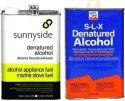
Denatured alcohol is usually sold in heavy, metal containers—much too heavy for trail use. Just reuse an old water bottle by pouring only as much denatured alcohol as you need into it. It looks just like water, however, so be sure not to accidentally take a swig of it during your hike!
How does denatured alcohol work?
I’m no chemist, but as I understand it, denatured alcohol evaporates into the air like water. Instead of calling it evaporating, however, they say the denatured alcohol vaporizes. It’s this vaporized fuel in the air that actually burns, accelerated by the oxygen in the air that surrounds it. The pool of fuel in the stove doesn’t burn at all—at least not until it vaporizes and mixes with the oxygen in the air.
Vaporizing fuel also expands, which is how the jets of the soda can stove work. The vaporizing fuel pushes through the little holes creating jets that catch fire. In theory, smaller and fewer holes increases the pressure and pushes the jets out further. In practice, I don’t really see much of a difference. The stove needs to warm up for a minute or so before the pressure in the side walls build enough to push the vaporized denatured alcohol out of the holes fast enough where they’ll catch fire and turn into jets.
In cold weather, alcohol does not vaporize as easily which can make starting the stove more difficult. If you’re in temperatures below freezing, you may need to hold your lighter against the fuel in your stove for several seconds. This will warm it up enough to start the fuel vaporizing, at which point it will catch fire and burn. Once the stove is burning, the heat from the stove will keep the rest of the fuel vaporizing.
What else can be used as fuel?
You can use pure ethanol in your soda can stove—it just costs more. The bonus, however, is you can also drink your fuel! Just to be clear, I’m not endorsing that you drink your fuel. Allegedly, it can be consumed, but really, if you want to imbibe a bit on the trail, buy something that was intended for drinking.

Pure methanol will also work in an alcohol stove. Methyl alcohol is also sold in hardware and paint stores as ‘wood alcohol’ and is the main ingredient in some automotive gas line de-icers such as HEET. In a pinch, HEET can be found in many gas stations, convenience stores, and auto-parts stores if denatured alcohol isn’t readily available. HEET comes in two versions: yellow and red—make sure to get the yellow. Yellow is methanol alcohol while red is isopropyl alcohol, and the red HEET creates an enormous amount of soot that’s just awful to clean up. The red HEET will heat your food, but you’d probably end up wishing you didn’t use your stove at all.
I’ve also been told that methanol is extremely poisonous and therefore needs to be used in a well-ventilated area. If you use methanol for long-term use, it might even be safer to store your stove in something other than your cook pot so whatever residue chemicals are left on your stove don’t leach into your pot.
What can I use for fuel outside of the United States?
I live in the United States and don’t know much about how denatured alcohol is sold or even what it’s called in other locations. So anyone who has information about what can be used in other countries, let me know and I’ll add it here. Even if a specific country is listed below, it’s almost certainly not a complete list of commonly used names for denatured alcohol, nor are these fuels I’ve personally tried.
| Countries | Look for.... |
|---|---|
| Australia |
Often called “metho”—short for methylated spirits.
|
| Canada |
Marine Alcohol made by Captain PHAB
Methyl Hydrate at Canadian Tire and lots of paint stores
|
| Denmark |
denatureret alkohol, denatureret sprit, køkkensprit (kitchen spirit), husholdningssprit, sprit
(Available in most hardware stores, the biggest three being Bauhaus, Silvan and Jem&Fix. Often available in regular supermarkets such as Føtex, Netto, Fakta, Kvickly and Brugsen.)
|
| Finland | |
| France |
alcool denat, Ciron Alcool a Bruler
|
| Germany |
 Brenn Spiritus (burning alcohol) is often sold in drugstores and supermarkets for use in camping stoves. One popular brand comes in a green bottle. Brenn Spiritus (burning alcohol) is often sold in drugstores and supermarkets for use in camping stoves. One popular brand comes in a green bottle. |
| Greece |
Φωτιστικό Οινόπνευμα - 95% (which literally means “Lighting Alcohol 95%”)
|
| Netherlands |
brandspiritus
Bever Brandstof Methylalcohol/Bever Spirit, available at the nationwide camping supply store known as Bever
|
| Norway |
T-röd by Kemetyl (available in every gas station and most stores)
Tenol by Kemetyl (etanol/metanol mix that will burn with less soot but is slightly more difficult to find)
|
| Philippines |
Flying Tiger; Puree Denatured Alcohol; Hawaiian Flame
|
| Poland |
denaturat, alkohol denaturowany
|
| Portugal |
álcool etílico
|
| Scotland |
methylated spirits (probably purple... and definitely not white spirit!)
|
| Spain |
alcohol denat, Vivó Alcohol 96°
|
| Sweden |
T-röd by Kemetyl (available in every gas station and most stores)
Tenol by Kemetyl (etanol/metanol mix that will burn with less soot but is slightly more difficult to find)
Rödsprit (it’s pink and burns a bit dirty)
|
| Switzerland |
Brennsprit
|
| Southwest Asia (Myanmar, Cambodia and Vietnam) |
Hardware stores can be hit or miss, but medical supply places (pharmacies, drug stores, etc) almost always have near 100% alcohol for sterilization
|
In a country not listed above?
In 2012, I hiked through France and Spain and needed to find some denatured alcohol. Not having any idea what it was called locally, I still managed to find something that worked in both countries. In France, I walked into a hardware store. The clerk didn’t know any English, and I didn’t know any French, so I just started looking around the paint area for anything that seemed ‘suspiciously’ like denatured alcohol. Soon, another customer who did know English walked in, and I described what I was looking for—a fuel to use in a stove (he didn’t understand the term ‘denatured alcohol’) and pointed out a bottle (in the paint section) that had a picture of a camp stove and a lantern. Ah-ha!
Looking at pictures like this is great if you don’t know the language, but you do have to be careful. What if it’s white gas? That’s also a liquid fuel used for stoves, but it’s not suitable for soda can stoves. It would likely explode if you tried to light it! So I looked at the back of the bottle which, not surprisingly, was in French.
Now it’s time to look for what are called cognates—words that appear to be very similar to their English-language counterparts. Looking at the back of the French label, I see words such as “alcool ethylique”, which I strongly suspect means “ethyl alcohol” (exactly what we want!), and just below that, it reads “Dénaturé à 90% volume” which looks suspiciously like “denatured to 90% volume”" (again, exactly what we want to see). As a general rule, the alcohol content should be at least 90% if it’s going to burn hot enough to make a good fuel for a soda can stove.


There’s still no guarantee that the fuel will burn cleanly—it might be so sooty that you’d wish you never used it at all, but the only way to test for that is to buy it and try it. In this case, when I tried it, the fuel burned cleanly and I used it throughout my hike in France.
In Spain, I stumbled onto a small bottle of what appeared to possibly be denatured alcohol. This one said nothing about using the alcohol in stoves, but the back of the label had “Alcohol denat” which I suspected was a cognate for “denatured alcohol”, and the “96°” on the front of the bottle suggested to me that it was 96% pure. The ingredient list also had a couple of items that I wasn’t familiar with (isopropyl and triclosan), but denatured alcohol always has stuff in it to make it undrinkable. I didn’t know if these extra ingredients would burn cleanly or make it otherwise unsuitable for cooking purposes, but I went ahead and bought the bottle which turned out to work perfectly well.


Then there was my trip to Scotland. You’d think finding denatured alcohol might be a little easier there—at least they speak English! But there are a couple of things to watch out for.... When I walked into a hardware store, the first bottle I saw was for ‘white spirit.’ It was tempting to think that might work, but it’s a cognate for ‘white gas’ which is definitely not for soda can stoves.
Near the white spirit, however, I found a purple bottle of methylated spirits. Not denatured alcohol—not exactly—but close enough for our purposes! But then I noticed another bottle of clear liquid sitting right next to it also labeled methylated spirits! Which to use? Purple or clear? The purple bottle was labeled “for use with camping stoves” while the clear fuel was described as “for cleaning and degreasing purposes” which settled the matter easily enough. I suspect that either one can be used for either purpose, so why the difference? I’m not sure, but if I had to guess, the additives in the two are slightly different. Fuel for camping stoves needs to burn cleanly, while for cleaning and degreasing, perhaps some other additive would work better but burns dirty making it unsuitable for stoves.


So, in a nutshell, when looking for denatured alcohol in a foreign country, look for pictures and cognates. Make sure it’s denatured alcohol rather than white gas, and check that it’s at least 90% pure. There’s still no guarantee if it’ll work well as a fuel until you try it, but at least you’ll likely be headed in the right direction!
How much denatured alcohol do I need?
For shorter trips, I repurposed a small, plastic water bottle to store my denatured alcohol. For longer trips, I use a larger water bottle. Keep in mind that you do not have to fill these containers completely to the top if you really don’t need that much fuel so use whatever sized bottle that best suits your purposes.
On my thru-hikes, I’ll use a 20 oz. water bottle for my fuel which—when full—typically lasts me about two weeks, cooking one meal per day. Your results may vary. I took about one month to thru-hike the Long Trail and decided to stretch my fuel by not resupplying it on the entire trip. I did cook meals every night, then snuffed out the flames and poured what was left back into the bottle—and I made it last for the entire one-month hike! If you need to melt snow for water, you’ll need a lot more fuel than you would normally carry for cooking purposes.

Some people, because it looks so much like water, will slap on masking tape with a large X or somehow mark the bottle to indicate that it’s not safe for drinking. I don’t, but I never use the same kind of bottle for drinking water and for storing fuel so have never accidentally tried to drink denatured alcohol, but it is something to be weary of if your drinking bottle is similar in size and shape to your fuel bottle. Be sure not to store such bottles where someone might inadvertently take a swig of it thinking it’s water and keep it out of the reach of children.
What if my stove burns sooty?
The stoves themselves don’t burn sooty—it’s the fuel that burns sooty. I can’t vouch for every brand of denatured alcohol out there, but in my experience, it’s usually not an issue.
I once purchased True Value branded denature alcohol, and while it certainly burned hot enough, it was incredibly sooty. I’ve tried Ace branded denatured alcohol and it worked great, and I’ve purchased some at Home Depot which worked great. A lot of hardware stores carry the Sunnyside brand which works great. Of my denatured alcohol purchases, that True Value branded stuff is the only one I ever had a problem with. I don’t know what sort of additives they use, but whatever it is, it burns very sooty and makes an enormous mess. (At least it did when I tried it in 2005. Their formula, obviously, could have changed since I used it.)
If you find yourself with a brand of denatured alcohol that burns sooty, the only thing you can do to fix this problem is buy a different brand and try that instead. Ace, Sunnyside, S-L-X, and Crown brands have all worked well for me. The True Value brand did not. Outside of that, I have no idea.
Can I travel (e.g. fly) with my stove/denatured alcohol?
Traveling with your stove shouldn’t be a problem. I’ve flown many times with my soda can stove in my carry-on bags and the TSA agents never batted an eye over it.
Flying with flammable liquids is definitely not allowed, however—not in either your checked bags or your carry-on bags—so purchase your fuel after you’ve arrived at your destination.
If you carry a lighter or matches for your stove, I’m fairly certain they aren’t allowed in your carry-on bags. To be honest, I’ve never checked if they’re okay in checked bags. I always put my lighter in a checked bag, though, and I figured if TSA doesn’t like it, they’re more than happy confiscate it. They aren’t particularly expensive and I can easily buy a new one at my destination. It’s never been confiscated, though!
For other modes of transportation such as trains or buses, I can’t say definitively what the rules are. It would be best to check the website of whoever you’re traveling on.
However, with that said, I would just travel with it all. I’ve ridden Amtrak and Greyhound buses before, and they’ve never searched my bags or put me through X-ray scanning machines. Even if carrying high combustible fuel such as denatured alcohol isn’t allowed, they don’t seem to care enough about it to search you for it. And admittedly, if a fire breaks out on a train, it’s a lot easier to stop and evacuate than a plane flying at 30,000 feet! But if you do travel with your denatured alcohol and a lighter, it’s probably not a good idea to actually try using it during your trip. The powers-that-be might not care if you have it, but they may very much care if you try using it! And the risk of starting an out-of-control fire on a bumpy train or bus is considerably greater than it would be on a stable picnic table or a rock deep in the woods. A little common sense goes a long way!