
Rumors, Myths & Lies of the Alcohol Stove
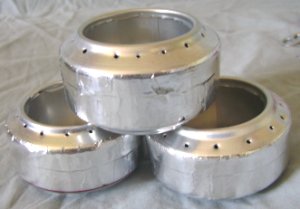
An alcohol stove is the cheapest, lightest, most reliable stove you’ll ever own, but they don’t always get much respect. Magazines such as Backpacker get good advertising dollars from companies who manufacture and sell stoves, and those companies wouldn’t be happy about the magazine encouraging people to make their own stoves. Website that sell stoves do not want you building your own stoves, and they’ll often tell you misleading facts and flat out lies to scare you away from them. So let’s discuss the most common rumors, myths and lies of the alcohol stove.
- Myth: Alcohol stoves don’t really work
- Myth: Alcohol stoves aren’t reliable
- Myth: Alcohol stoves are dangerous
- Truth: Alcohol stoves crush easily
- Myth: Alcohol stoves don’t work at high altitudes
- Myth: Alcohol stoves don’t work in low temperatures
- Rumor: You can’t simmer with an alcohol stove
- Rumor: The weight of the fuel makes an alcohol stove heavy to carry
- Myth: Pepsi cans make the best soda can stoves
- Rumor: Penny can stoves are the best alcohol stove
- Rumor: You don’t need a pot stand for a soda can stove
Myth: Alcohol stoves don’t really work
Yes they do! Ten-thousand thru-hikers can’t be wrong! However—every stove has limitations and alcohol stoves are no exception. You must decide if you can live with their limitations or if a commercial option might be better suited for your purposes.
These are 3-season stoves and not suited for extreme winter conditions—doubly so if you have to melt snow for water. It’s not well-suited for cooking large amounts of food so if you have a hiking partner or two, a commercial stove may work out better. If you enjoy creating elaborate meals in the backcountry such as pizza or cinnamon rolls, these stoves are not ideal. (It can be done, but it’s not easy.)
The light weight of the stove makes it perfect for backpacking, but on rafting trips or while car camping where weight is not an issue, a traditional stove may be more comfortable to use. An alcohol stove also doesn’t cook quickly, so hikers who don’t want to wait for hot cocoa in the morning or dinner at night, the slow cooking speed may be irksome and a commercial stove might better fit your needs.
But to claim the stove doesn’t work at all is a joke. Thousands of hikers use them every year without any problems at all.

Myth: Alcohol stoves aren’t reliable
Thru-hikers everywhere carry them thousands of miles without trouble. They have no moving parts that might break and no filters that can clog. As a result, they tend to have fewer problems than commercial stoves.
I’ve carried soda can stoves about 8,000 miles (and going!) and never had a failure. Roland Mueser surveyed hikers on the Appalachian Trail for his book, Long-Distance Hiking, and this was the only type of stove with a 0% failure rate. If the worst should happen, however, the stove is easily replaced with materials found at the local hardware store for a few bucks.
Myth: Alcohol stoves are dangerous
All stoves can be dangerous, and alcohol stoves are no different. However, I’m labeling this as a myth since whenever someone says it, they try to imply that a homemade alcohol stove is somehow more dangerous than commercial stoves. Not true.
Treat your stove with respect and take simple precautions. The fuel can easily spill if you knock the stove over or someone bumps the table too hard where you’re cooking. Once, while trying to snuff out the flame, I accidentally knocked a lit soda can stove into my lap and my crotch caught on fire. So yes, they can be dangerous, but all stoves can be dangerous if you don’t treat them with respect. Remember these simple precautions:
- Don’t cook on a surface that can catch fire.
- Make sure there are no flammable materials near your stove when it’s lit.
- Always have a full bottle of water nearby as your emergency fire extinguisher.
- In daylight, the flame is nearly invisible—be careful not to burn yourself on it.
- Consider your environment—if it’s very windy and controlling the flame is difficult, it may be safer not to use your stove at all.
- Don’t add fuel to a stove that’s already burning.
- Never use your stove in your tent!
- Don’t use your stove in an enclosed area without ventilation. I’ve heard that alcohol stoves won’t cause carbon monoxide poisoning, and maybe it’s true, but why take the chance? Regardless, I don’t know what kind of chemical reactions occur when the fuel burns, and it seems prudent to not go inhaling the results.
- Never leave a burning stove unattended.
- Alcohol stoves get hot—wait a few minutes for it to cool before handling the stove or putting it away after use.

Truth: Alcohol stoves crush easily
Ah, well, guilty as charged. They’re made of stuff like soda cans and cat food cans, so yes, they crush easily. However, there’s a simple solution to this problem: Don’t crush your stove. Store the stove in your cook pot or some other hard-sided container when it’s not in use.

Myth: Alcohol stoves don’t work at high altitudes
Many people will claim that alcohol stoves don’t work at high elevations, or at least that they don’t burn as efficiently. Technically, this may or may not be true—but I’ve tried this stove as high as 13,000 feet above sea level (Forester Pass) and it worked just fine. I have little doubt they would work anywhere in the contiguous United States (which tops out at 14,505 feet above sea level at Mount Whitney), so for all practical purposes, elevation is not something you need to worry about. If you are climbing seriously high-altitude mountains, an alcohol stove might not be ideal if only because it’s not well suited for melting snow. If you have an appointment to climb Mount Everest, I’d love it if you took an alcohol stove with you and tried it out. Let me know the results and I’ll post them here.
June 26, 2018 Update:
While nobody has taken a soda can stove to the top of Mt. Everest (so far as I know), one person did email me that he used a soda can stove in the mountains of Nepal at 5000 meters (16,400 feet) above sea level and it worked fine.
But do they burn less efficiently at high altitudes? Again, technically, this may or may not be true—I don’t really know—I don’t sit around timing how long it takes to boil water at various elevations. However, when I used the stove at 13,000 feet above sea level, I didn’t notice any difference in performance than when I used it at sea level. Maybe it does burn less efficiently at high altitudes, but if so, it’s not a big difference. One person who does sit around doing timing tests e-mailed me said he didn’t measure any difference between stoves at sea level and stoves at 7,100 feet above sea level.
So for all practical purposes, I’m calling this a myth. There is probably a decrease in fuel efficiency at higher altitudes, but for practical purposes, it’s not much and the stoves certainly do work.
Myth: Alcohol stoves don’t work in low temperatures
I’ve used the soda can stove in temperatures as low as 20°F (-6.7°C) without any noticeable loss of performance. Perhaps it might stop working at temperatures lower than that, but one person e-mailed me saying they’ve tried melting snow with an alcohol stove in temperatures as low as -25°F (-37°C) without any trouble, and I’ve heard that the Swede and Finnish armies use alcohol stoves all year—including their quite cold (-40°) winters.
If you’re trying to cross Antarctica on foot, there are better reasons not to use an alcohol stove—melting snow takes a lot of energy and the amount of denatured alcohol you’d need would far outweigh the benefits of a light stove. But by all means, if you are traveling to the South Pole in severely cold temperatures, take an alcohol stove and run some experiments. I’ll post the results here!
One note about cold temperatures—it can be more difficult to get the stove started. The denatured alcohol doesn’t vaporize as easily in cold weather, and when you light the stove, it’s actually the vaporized denatured alcohol that burns. If you hold a flame to the alcohol, it will warm up enough to vaporize and catch, but it might take a bit longer and be a bit more difficult to start than it would on a warm, summer evening. Once the stove is lit, however, I’ve seen no difference in performance for the stove.

In related news, I got an email from Roger from Sweden who suggests dealing with really low temperatures by preheating the alcohol and burner. Trangia, an old Swedish manufacturer of alcohol stoves, sells a device that is mounted underneath the burner. You put a few drops of the denatured alcohol on a primer fabric which then ignites for some reason. He also tells me that people who haven’t bothered to buy a primer unit have used tealights in the same way. I’d imagine that you could also keep a small bottle of alcohol in an inside pocket to keep it warm with your body heat. (I suspect it’s more useful to preheat the alcohol than it is the burner, but be careful not to set yourself on fire—denatured alcohol is flammable, after all!)
In a nutshell, though, alcohol stoves do work in low temperatures, even if they might be a little bit more challenging to get started.
Rumor: You can’t simmer with an alcohol stove
I use a simmer ring all the time, and even created a section specifically about how to use a simmer ring. It’s not a finely controlled flame, however—the stove basically comes with three settings: full blast, simmer, and off. You could, in theory, have multiple simmer rings with different sized holes for different amounts of simmering, but that seems like overkill. I’ve been able to bake pizzas with a soda can stove using the simmer ring, but it’s better suited for actual simmering.
There are alcohol stove designs that make it all but impossible to use a simmer ring attachment such as the cat food can stove, but the soda can stove does not have this limitation.

Rumor: The weight of the fuel makes an alcohol stove heavy to carry
It’s true that the denatured alcohol of an alcohol stove does not burn as hot as a commercial stove; therefore you will need more fuel to generate a given amount of energy than you would need if you used a canister or white gas stove. However, this is a gross simplification of the issue and, most of the time, I think such conclusions are flat out wrong.
If you’re on a short overnight or weekend trip, liquid fuel has the advantage that you can take only as much as you need for a trip. The canister stoves are relatively hefty (even when empty!) and you have no control over how much fuel to take with you. The white gas stove does allow you to take only as much fuel as you need, but the system to pressurize the stove is quite hefty, so several days worth of denatured alcohol may still weigh less than the added weight of a white gas stove.

If you’re out in the backcountry for an extended amount of time, the starting weight for an alcohol stove and fuel may be heavier, but after a few days of use, the whole system may actually weigh less. Denatured alcohol doesn’t burn as efficiently, so you burn it up much more quickly than you would using other fuels. By the time you hike out back into civilization, the combined stove and fuel weight will definitely be lighter than a canister or white gas stove.
When I hike, I consider a unit of measurement called weight-distance. Multiply the weight times the distance to get weight-distance. If you carry one ounce for one mile, that’s one ounce-mile. If you carry one ounce for 20 miles, that’s 20 ounce-miles. If you carry 20 ounces one mile, that’s also 20 ounce-miles. Why is this important? Because I think that’s the fairest way to determine if your soda can stove is lighter than other alternatives. I’ll readily admit that I totally made up this unit of measurement, but it’s fair representation of comparing different systems with each other and can be used for any sort of system—not just for stoves and fuel.
Metric system: If you live in some other part of the world than the United States, you probably think in grams and kilometers. It’s entirely valid to use “gram-kilometer” or “kilogram-kilometer” (kg-km) units rather than “ounce-miles.” Use whatever system of units works best for you!
Let’s say you use, on average, one ounce of denatured alcohol each night for dinner with your stove. If you go out for six days (five nights), you need to start with 5oz of fuel. My cookset weighs in at 9oz, so for me, my starting weight in this scenario would be 14oz on Day 1. Calculate the weight-distance for each day and add them together to get the total weight-miles:
Day 1 =  14 * 10 = 140
Day 2 =  13 * 10 = 130
Day 3 =  12 * 10 = 120
Day 4 =  11 * 10 = 110
Day 5 =  10 * 10 = 100
Day 6 =   9 * 10 =  90
                  --------
                 = 690 oz-miles (or 43.1 lb-miles)
Also note that a fluid ounce is not the same as an ounce. A fluid ounce is a unit of volume, and we’re more interested in the actual weight of the fuel. A “20 ounce” bottle refers to 20 fluid ounces—the actual weight of the liquid in such a bottle can be more or less than 20 ounces. When it comes to calculating weight, just weigh the bottle with the fuel you plan to carry.
This is also a very contrived example. Most people don’t hike exactly ten miles each day, nor do they use exactly one ounce of denatured alcohol each night for dinner. This is just an example of how to do such a calculation, but this type of calculation is necessary if you truly want to know which cookset system is the lightest. I also believe it’s important to consider the weight of your entire cook system—not just the weight of the fuel, but also the weight of your stove, pot support, windscreen and other cooking accessories.
So ignore what other people have to say about the weight of their systems or how it compares to an alcohol stove. Only you can run these kind of calculations for yourself—assuming you feel it’s even worth the effort. Perhaps someone with a canister stove feels my 690 oz-miles (or 43.1 lb-miles) for a six day outing is too heavy, and frankly, when it’s written like that, it does sound heavy—it requires the same amount as effort as carrying 43.1 pounds one full mile—but it’s still lighter than alternatives I’ve tried.
If saving as much weight as possible from your back is the ultimate goal, consider not using a stove at all. My cookset weighs in at 9 ounces, which sounds light, until you consider that a thru-hike of the 2,650-mile PCT means carrying it requires 23,850 oz-miles (1,490.6 lb-miles). Would you carry 1,490.6 pounds across one mile of rugged terrain? Then why would you use the same energy to lug 9 ounces over a rugged 2,650 miles? It adds up! And this calculation doesn’t even include the weight of the fuel which is not trivial, but when you’re in the backcountry, those hot meals can be worth the trouble. =)
So if you’re comparing the weight of different cooking systems, figure out the weight-distance for each of them. That’s the only way to make an apples-to-apples comparison of different systems, and the calculations must fit your situation to be valid. As a general rule of thumb, you’ll find the numbers work out particularly well if you’re hiking alone (or maybe with one other companion), don’t do a lot of cooking, don’t have to melt snow for water and you tend to cover big miles between resupply points.
Myth: Pepsi cans make the best soda can stoves

Pepsi cans seems to dominate conversations of the soda can stove. I’ve made soda can stoves out of all sorts of cans including Pepsi, Coke, root beer, diet and regular, Christmas editions and once even made it out of a can of grape soda! I’ve found no difference in performance among any of the types of stoves.
The most popular theory for the rise of the Pepsi can is that older-model Coke cans didn’t have the circular crease at the bottom of the can to hold the inner wall in place. It’s probably true too, but I prefer the theory that the person who invented the soda can stove (or at least the person who first popularized them) was a big fan of Pepsi and suggested to his friends that he could build some extra for his friends... if only his friends bought him some Pepsi to do it with. =)
But as long you aren’t trying to use a flat-bottom can, drink whatever you like best. It really doesn’t matter.
Rumor: Penny can stoves are the best alcohol stove
Penny can stoves have a reputation of burning more efficiently than other alcohol stoves. They’re pressurized, at least more than other alcohol stoves, and the penny is used to vent the pressure so the stove won’t explode. I tried a penny can stove once and didn’t really see any difference. I’m not going to label this as a myth, though, because I didn’t sit around doing timing experiments. It very well might be true.
But where the penny can stove fails miserably is in easy-of-use—penny can stoves need priming, and it’s much more difficult and slow getting the stove fueled up. I’ve met several people who’ve tried the penny can stove, and none of them stuck with it for that reason. So I give the penny can stove a thumbs down. However, I will admit, it’s largely a personal preference, and there’s bound to be someone, somewhere who would genuinely prefer a penny can stove. I just don’t know any.
Rumor: You don’t need a pot stand for a soda can stove
There are soda can stove designs that do not require a separate pot stand, but the one on this website is not one of them. If you attempt to put your cooking pot directly on the stove, you will snuff out the flame.
The cat food can stove does not require a pot stand, however, and if that’s your goal, consider making that type of stove instead.
If you plan to cook food with your stove rather than just boiling water, I highly recommend using a stove design that allows for a completely separate support for your pot so you can stir your food without sloshing around the burning denatured alcohol. It’s a safety thing. Even if your stove doesn’t require a separate pot stand, you really should use one if you need to stir what you’re cooking.